
Let's Make This Co-op!
Because college is too expensive and there isn't enough meaningful work.

Starting to think
In January 2020 I rented a studio space in Pittsburgh with two friends. They were both artists working with clothing and textiles. I didn’t know exactly what I wanted to do, beyond spending more time with friends and working in the physical world.
I’d just finished reading, Never Home Alone: From Microbes to Millipedes, Camel Crickets, and Honeybees, the Natural History of Where We Live by Rob Dunn. It got me thinking maybe I would use the studio space to prototype products to improve the health of the microbiomes in our homes. For example, probiotic cleaning sprays or rugs made from plants. I was browsing microscopes and reading up on natural cleaning ingredients and essential oils while we set up the space.
We were still painting the walls when COVID-19 arrived full blast in March. Instead of a lively shared workspace, we each took turns working in the studio alone, wiping down surfaces with chemicals for the next one. Microbes were out of fashion.
The studio was a beautiful light filled space on the second floor of a house. In my area, a yellow circle was hand painted on the white floorboards. In this reflective space without the internet I turned my attention to “business arts”. I doodled. I worked out ideas with stickies on a table top. I taped papers to walls. I danced around to 88.3 WRCT or to my surviving CDs and daydreamed in the garden. I didn’t go every week, but when I did I tried to stay for as long as possible.
Creating value for entry-level workers
I had a bumpy start to my career. I graduated in 2009 with a liberal arts degree in urban studies and non-fiction writing from the University of Pittsburgh. My first job out of college was writing product descriptions and blog posts about children’s toys for $10 an hour. I was laid-off around 2011 and I mostly worked in restaurants until I started an MBA + Sustainability program at Duquesne University in 2013. After a six month post-MBA job search, I started my first job at a living wage in 2015. I value all of my educational experiences but they were far too expensive.
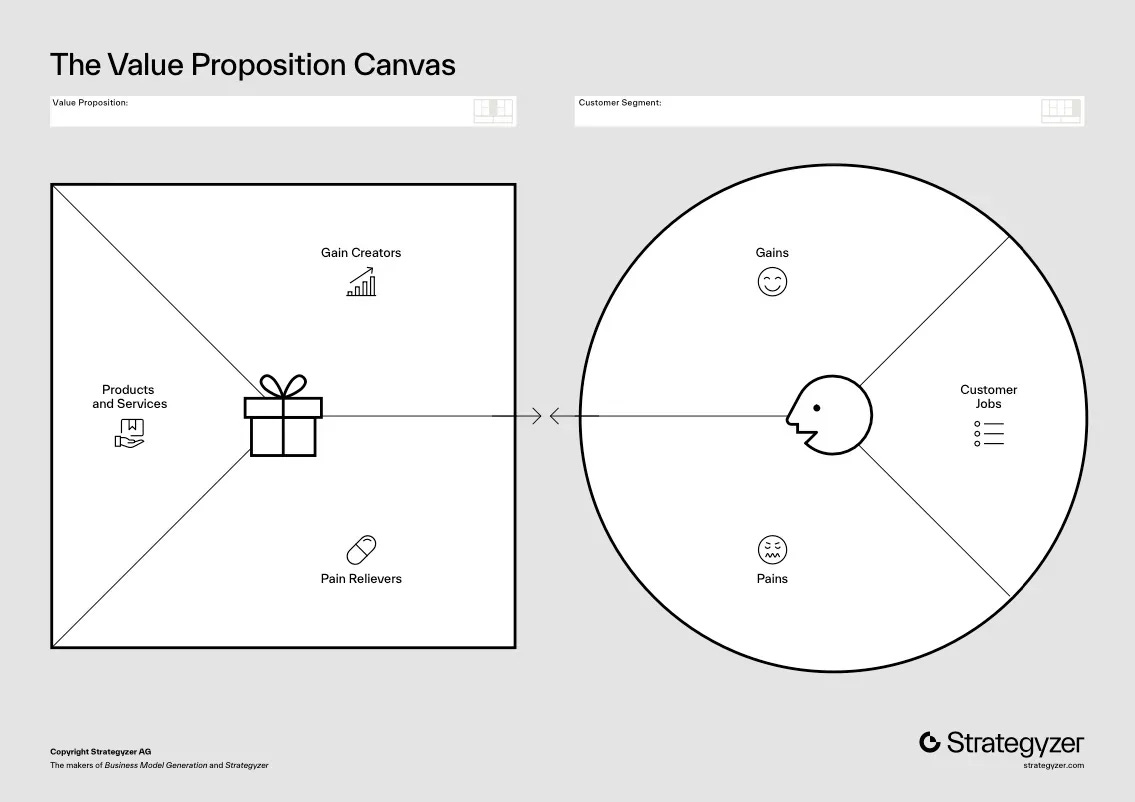
Image Description: A diagram of the Value Proposition Canvas. On the left side is a square with a gift box in the center symbolizing the value proposition. On the right is a circle around a cartoon profile of a customer symbolizing the customer segment. The square has three sections: "Products and Services" with a hand and box icon, "Pain Relievers" with a pill icon, and "Gain Creators" with a bar graph icon. The circle has three sections: "Customer Jobs" with a checklist icon, "Pains" with a frowning face icon, and "Gains" with a smiling face icon. Arrows connect the value proposition and the customer segment sides, showing their interrelationship.
In the studio it was a sunny spring afternoon in 2020 when I was leafing through the book, Value Proposition Design, and decided to start a Value Proposition Canvas. It’s a framework for exploring customer segments and value propositions. I learned to love frameworks in business school. They’re abstractions of complex systems that help people align their perspectives to analyze information, communicate, and make decisions.
Customer Profile
I started on the right side of the Value Proposition Canvas with the customer profile. What customer segment would I want to help? Based on my own experience, entry-level workers came to mind. In the jobs section of the customer profile, I started writing stickies about their potential needs, or as they’re framed in the value proposition canvas, the “jobs” that entry-level workers need to do.
As an entry-level or career transiting worker, I need to do these “jobs:”
Earn a living wage.
Learn and build skills.
Gain experience.
Do work that is meaningful to me.
As an entry-level or career transiting worker, I hope to gain:
Supportive colleagues, coaches, and mentors.
Flexibility in where and when I work.
Experience that will grow my career.
An expanded professional network.
As an entry-level or career transiting worker, I could be obstructed by these pains:
Racism, transphobia, ableism, sexism, homophobia, xenophobia, and/or other prevalent systems.
Impersonal, automated applicant screening systems.
Limited professional experience or not enough qualifications.
Lack of meaningful roles.
Roles that go against my values or endanger me.
Student loan debt.
Value proposition
On the left side, I began thinking of products or services that could support an entry-level or transiting worker and how those services could create the gains and relieve the pains from the right. Eventually the following ideas emerged:
Services to help entry-level or career transitioning workers:
Free school.
Paid apprenticeships.
Gain creators for entry-level or career transitioning workers:
Coaching, mentorship, and support from a network of diverse professionals.
Project-based learning on real projects.
Resume-worthy, quantifiable results.
Self-directed learning and growth opportunities.
Flexibility, work-from-home, and work-near-home.
Pain relievers for entry-level or career transitioning workers:
Inclusive culture that emphasizes intersectional diversity, equity, inclusion, accessibility and justice.
Flexibility powered by asynchronous collaboration.
Opportunities to explore new areas of specialization.
Availability of child and dependent care.
Flat organizational structure.
This value proposition exercise shaped the ideas to come. The question then became, how to deliver a paid-apprenticeship program as a potential alternative to a university liberal arts and sciences curriculum?
Image description: The logo for "This Co-op" features a photo of a bat in mid-flight with its wings fully extended, positioned over a thin red-orange circular outline. Below the bat in the circle, the words "This Co-op" are displayed in a bold, chunky sans-serif font with slightly rounded edges.
Introducing This Co-op
This Co-op’s purpose is to create meaningful work opportunities in Pittsburgh and surrounding communities through the design and delivery of environmentally and socially beneficial products and services.
Within the next five years, we’ll welcome our first class of apprentices. All of their coursework and project work will be contained within scheduled hours — no unpaid homework — creating flexibility to work a second job, take care of other responsibilities, pursue additional education, or do anything else that’s important to them.
A back-of-the-envelope estimate for paying apprentices a part-time living wage is $22,000 a year based on 25 hours a week for three, twelve week trimesters at $22 an hour. A class of six students, for example, would require at least $130,000 in available funds. Today’s funds are $0 so how do we get there?
Organizational structure
We first have to establish a thriving community of members who can work together to create innovative products and services that help people. We’ll do that by collaborating, using research and frameworks to workshop ideas together.
To organize our activities and collaborate, members would form “schools”, “departments,” and “teams.”
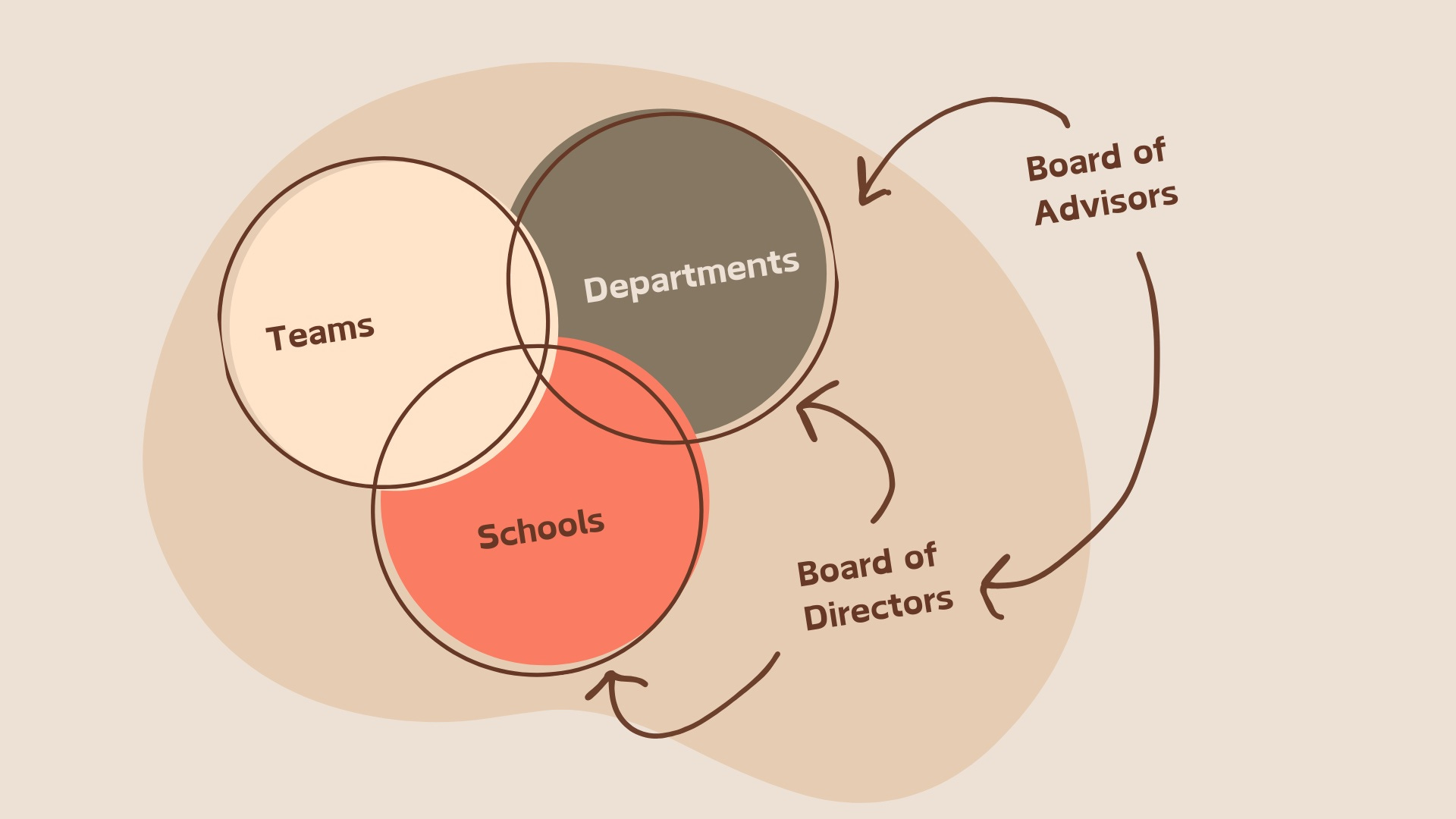
Image Description: A Venn diagram with three overlapping circles labeled "Teams” (light beige), "Departments” (dark brown), and "Schools” (red). The background has an organic shape in neutral earth tones. Inside the organic shape, arrows connect the words "Board of Directors" to the “Department” and “School”. Outside of the organic shape, arrows connect the words “Board of Advisors” to the “Department” circle and to the “Board of Directors.”
Schools are broad academic communities of interest where members have opportunities to learn, teach, and contribute to research. They drive content and knowledge creation to benefit This Co-Op and the broader community. School leaders are active members, elected by the members aligned to the school.
On the business side, members can align their skills and interests to departments like accounting, evaluations, accessibility, project management, finance, data, social media, organizational culture, risk management, legal and/or whatever is needed to support our operations. Departments are business units that help members develop specific job skills through participation in projects that support This Co-Op’s strategic goals. Department leaders are active members, elected by the members aligned to the department.
As projects emerge from our research and conversations, we can form teams to achieve specific objectives. Teams are temporary, self-organizing, inter-disciplinary groups of 2-to-9 members. Teams should find a school or to a department to sponsor their project, provide feedback, and to support.
Funding and ownership
As a cooperative, we’ll be member-owned. There isn’t the possibility of selling shares or seeking venture capital.
The challenge is we can’t really say what we’ll do until we have a diverse group of active members collaborating. Once we have a viable plan for a product or service, we can consider applying for a loan. There are also grants and resources available through start-up competitions. For example, in November 2021 I entered This Co-op — then called the Applied Arts and Sciences Co-op — into the Duquesne New Venture Challenge. I understandably didn’t get far. I was pitching an organizational model while other applicants were pitching products with prototypes and business plans.
Since we’re building a learning enterprise at This Co-op, we could develop services based on our ability to curate and apply local knowledge. As we grow we might expand into physical products that rescue materials from waste streams. If we focus on very-local geographic markets, like neighborhoods, unique customer profiles and value propositions can emerge.
One thing we can not do is collect fees or funds from members. We don’t want to create barriers or set up a power imbalance that way, even if it’s a perception.
Membership hours
Instead, members will make a commitment to work a minimum number of hours per quarter. This work can include a wide range of activities like researching topics of interest, contributing to school or department planning, building internal knowledge bases, designing and implementing member recruiting events, meeting with other members to share ideas and research, attending orientations and internal events, etc.
I’m currently testing out what it feels like to work an average of three hours per week on This Co-op related activities. There are famously 52 weeks a year, so 13 weeks in a quarter. Three hours a week multiplied by 13 weeks is 39 hours per quarter. While more members are needed to decide the actual requirements, so far, 39 hours a quarter seems sustainable for me.
Whatever we’re doing, we should truly enjoy it and believe it will have a positive impact. In exchange for that time well spent, members get free access to any of our educational programs, first consideration for any paid, non-apprenticeship jobs we eventually create and they are owners with voting rights. If we’re successful, they’ll also be able to vote to distribute dividends or invest in additional benefits for members.
What’s next?
Member recruiting and retainment is the critical next step.
I’m getting started by testing out membership on myself. It’s January 30, 2025 and I’ve been writing this for over a month. I regret not tracking my time on it, but I’m going to fix that in February. Next week I’m going to create my personal learning plan. I’ll keep talking about This Co-op at parties, community and networking events and I’ll share updates here.
By spring, I hope to find a few people to join the effort as members or advisors. And when we have a few members, I’m imagining a This Co-op Library Recruiting Tour with workshops and info sessions.
As we gain members, This Co-op’s activities will involve holding virtual and in-person recruiting events; forming schools and business functions; creating digital content; designing products and services; meeting up to collaborate in libraries and coffee shops; designing our bi-laws; registering our cooperative, launching our first paid products and services; designing and testing the apprenticeship experience and more.
Subscribe to This Co-op Substack to follow along as we grow!
And please contact me on LinkedIn or Substack to talk more about becoming a member or advisor. I’d love to hear what you think!
References & further reading
Glasmeier, A. K. (2025). Living wage calculation for Pittsburgh, PA. Massachusetts Institute of Technology. Retrieved from https://livingwage.mit.edu/metros/38300
Osterwalder, A., Pigneur, Y., Bernarda, G., & Smith, A. (2014). Value proposition design: How to create products and services customers want (T. Papadkos, Designer). Hoboken, NJ: John Wiley & Sons.
Spitzberg, D. (2021, August). Introducing the ownership model canvas. Start.coop. Retrieved from https://medium.com/start-coop/introducing-the-ownership-model-canvas-62244cb36a55
Wilson, C. (2017). The Work and Life of David Grove: Clean language and emergent knowledge. Leicester, UK: Troubador Publishing Ltd.
Strategyzer AG. (2024, April). The business model canvas. Retrieved from https://www.strategyzer.com/library/the-business-model-canvas
Strategyzer AG. (2024, April). Value proposition canvas. Retrieved from https://www.strategyzer.com/library/the-value-proposition-canvas
Duquesne University. (2024). New venture challenge. Duquesne University Palumbo-Donahue School of Business. Retrieved from https://www.duq.edu/academics/colleges-and-schools/business/team-competitions/new-venture-challenge.php
The views expressed are my own and do not represent those of my employer, PwC, or its affiliates.